

Hybrid Training
For those individuals looking for something other than just running races to train for, meet hybrid racing. Hybrid training/racing combines functional strength activities with running. This is a rapidly evolving field that has exploded in popularity. Below is a review of the options currently available in the US.
HYROX
One of the first races on the scene was HYROX. It was developed in 2017 in Germany by Christian Toeztke and Moritz Fueste (a former Olympic medalist). The race combines 1k runs with eight different functional fitness exercises designed to be accessible for both competitive athletes and recreational gym-goers alike.
HYROX offers multiple categories to accommodate a wide range of abilities, including an adaptive division. There is also a Pro category with heavier weights for those looking for an additional challenge. Competitors in the doubles division complete all running segments together and split the workout stations as they choose. A relay option is also available, in which teams of four complete two runs and two stations per athlete.
Each athlete begins with a 1,000-meter run and then alternates between running and workout stations, totaling approximately five miles of running. The stations are listed below, along with the men’s and women’s Open division weights:
- 1000m Ski Erg
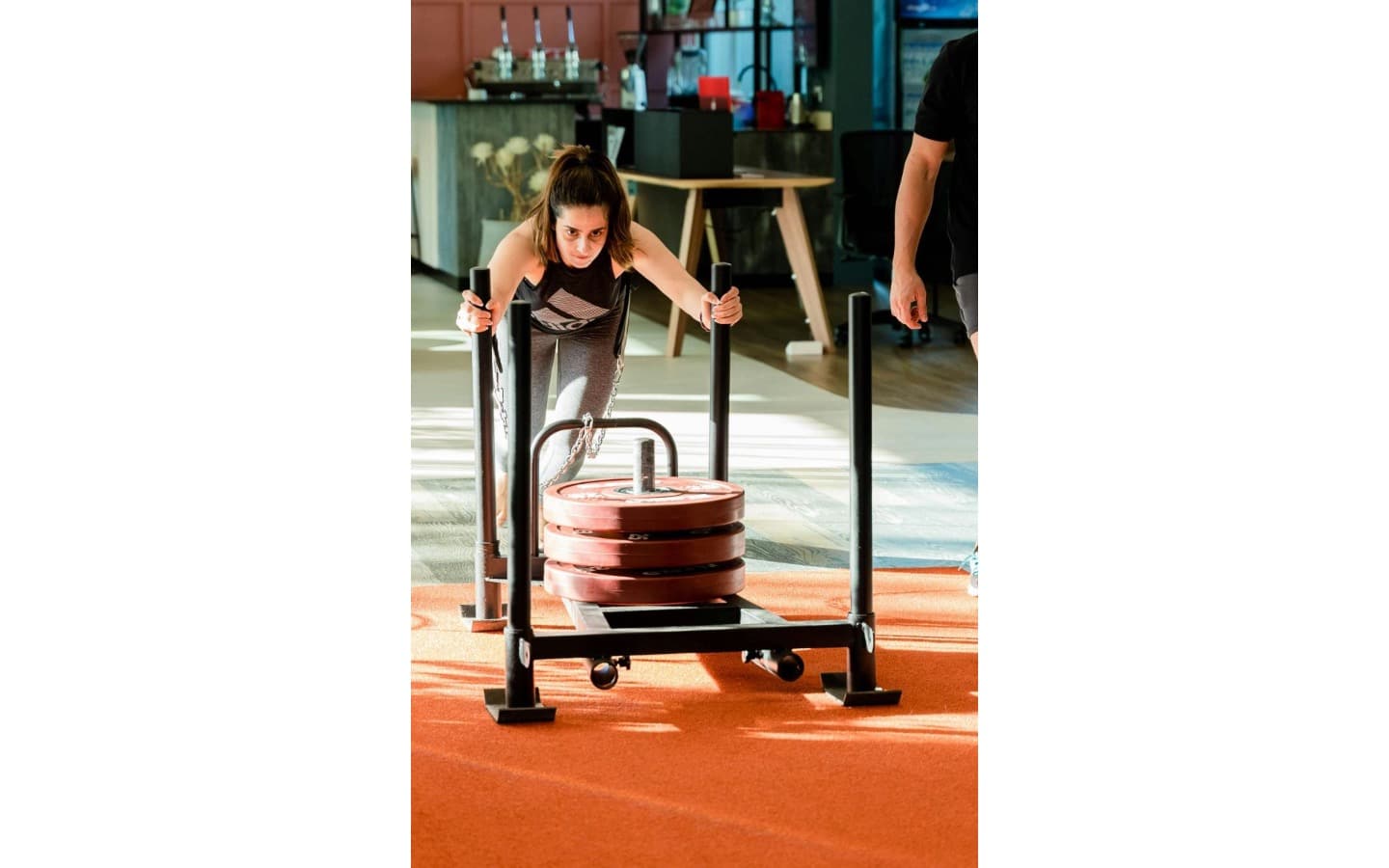
- 50m Sled Push (M 335lb/W 225lb)
- 50m Sled Pull (M 227lb/W 172lb)
- 80m Burpee Broad Jumps
- 1000m Row
- 200m Kettlebell Farmers Carry (2x 53lb M/35lb W)
- 100m Sandbag Lunges (M 45lb/W 22lb)
- 100 Wallballs (M 13lb/W 9lb)
There are movement standards for each exercise, with judges present to monitor technique. These races are now offered worldwide and often take place in convention centers in major cities. The sport has exploded in popularity, with tickets for most events selling out rapidly after release. The atmosphere at these events is electric—there is a DJ, and spectators can get quite close to the action. The community is very supportive, with participants representing a wide range of abilities.
DEKA
DEKA was created in 2019 by the founders of Spartan racing. The goal was to provide an accessible way to test and improve fitness. The founders aimed to “gamify” fitness by offering medals and T-shirts to all finishers and fostering a fun, supportive atmosphere.
DEKA offers three different race formats: DEKA Strong, DEKA Mile, and DEKA Fit. DEKA Strong includes only functional strength exercises, with no running. DEKA Mile features a 160-meter run between each station, totaling one mile of running. DEKA Fit includes a 500-meter run between each station, totaling a 5K run.
DEKA Mile and DEKA Strong events are often hosted at local gyms. DEKA also adjusts weights for youth competitors aged 10–13 and for participants over 65 years old.
The ten stations include:
- 30 alternating reverse lunges with a RAM (tubular weight) held on one or both shoulders (Men <65: 55 lb; Women & Men 65+: 33 lb; Youth & Women 65+: 22 lb)
- 500 m row
- 20 box step-overs on a 24” box
- Medicine ball sit-ups (Strong or Mile) or medicine ball throws (Fit) (Men <65: 20 lb; Women & Men 65+: 14 lb; Youth & Women 65+: 10 lb)
- 500 m SkiErg
- 100 m dumbbell farmer’s carry (2× Men <65: 60 lb; Women & Men 65+: 40 lb; Youth & Women 65+: 20 lb)
- 25-calorie Assault Bike
- Deadball shoulder-over (Strong and Mile) or wall-over (Fit) (Men <65: [weight as specified by event])
- 100 m tank push/pull (Resistance varies based on tank used)
- 20 burpees with RAM (Men <65: 44 lb; Women & Men 65+: 22 lb; Youth & Women 65+: 11 lb)
Even more than HYROX, DEKA attracts a wide range of abilities and ages. There is also an option to compete in DEKA Fit with a partner. One key difference with DEKA is that all portions of the race—including the running—can be divided between partners. In general, DEKA tickets are slightly easier to obtain.
DEADLY DOZEN
This is the newest hybrid race available. The first races were offered in the U.S. this year, while the inaugural events took place in the U.K. in 2024. It was developed by Jason Curtis from the U.K. and consists of twelve 400-meter runs on a track, with twelve “labors” performed inside the track between each run.
The exercises consist of:
- 240 m kettlebell farmer’s carry (2× men: 53 lb; women: 35 lb)
- 60 kettlebell deadlifts (men: 70 lb; women: 53 lb)
- 60 m walking lunges (2× men: 30 lb; women: 20 lb)
- 60 alternating dumbbell snatches (men: 35 lb; women: 20 lb)
- 60 m burpee broad jumps
- 60 kettlebell goblet squats (men: 35 lb; women: 26 lb)
- 240 m weight plate front carry (men: 55 lb; women: 45 lb)
- 60 dumbbell push presses (2× men: 30 lb; women: 15 lb)
- 120 m bear crawl
- 60 weight plate clean and presses (men: 35 lb; women: 25 lb)
- 180 m overhead weight plate carry (men: 35 lb; women: 25 lb)
- 20 devil’s presses (2× men: 25 lb; women: 12 lb)
There are also options to complete this race in a gym setting with no running or by using ergs instead. One of the main draws of this event is the minimal equipment required—each exercise uses only dumbbells, kettlebells, weight plates, or bodyweight—which enhances accessibility. The event can also be completed in doubles (with the work divided between partners) or as a relay, where each participant completes three stations and runs.
All of these races offer a fun challenge and feature supportive participants and volunteers!
by Eilish O’Sullivan