

Vertigo and BPPV
Benign paroxysmal positional vertigo (BPPV) is one of the most common and most treatable causes of dizziness. It typically presents as brief episodes of spinning triggered by simple movements such as rolling in bed, looking up, or bending down.
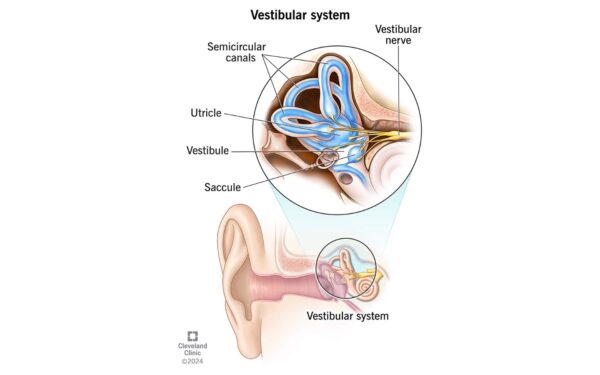
The vestibular system in the inner ear (pictured below) is responsible for sensing motion and maintaining balance. It has two key components:
• Semicircular canals (3 total): detect rotational movements of the head
• Otolith organs (utricle and saccule): detect linear motion and gravity
Within the utricle are tiny calcium carbonate crystals called otoconia. These crystals normally help your body sense position relative to gravity.
In BPPV, these crystals become dislodged and migrate into a semicircular canal (most often the posterior canal). When you move your head:
• The crystals shift within the canal
• This causes abnormal fluid movement
• The brain receives a false signal that you are spinning
This mismatch between inner ear input and visual/proprioceptive input produces vertigo and characteristic eye movements (nystagmus).
BPPV is often idiopathic, meaning there is no clear cause, but several risk factors are well supported in the literature:
• Aging (degeneration of otoconia) (Fujimoto et al., 2018)
• Head trauma or concussion (Andersson et al., 2021)
• Vestibular disorders (Karabulut et al., 2025)
• Prolonged immobility (Fu et al., 2020)
• Osteoporosis, altered calcium metabolism, and hormonal changes (Yamanaki et al., 2016) (Liu et al., 2017)
• Vitamin D deficiency (increasingly recognized) (Talaat et al., 2016)
There is growing evidence that BPPV may have a seasonal pattern, though it is not entirely uniform across studies (Saeed, Omari, 2016). There appears to be a higher incidence in winter and early spring, with increased visits during the months when vitamin D tends to be the lowest.
Physical therapy, specifically vestibular rehabilitation, is the most effective treatment for BPPV.
A trained therapist will:
• Perform positional testing (e.g., Dix-Hallpike)
• Identify the involved canal and direction of nystagmus
• Apply targeted canalith repositioning maneuvers such as the Epley maneuver, which is the most commonly used maneuver
BPPV is a mechanical problem, and the treatment is mechanical as well. The goal is to move displaced crystals out of the semicircular canal and back into the utricle, where they no longer trigger abnormal signals.
Most patients improve in 1–3 visits, often with immediate relief of symptoms.
While vertigo can be unsettling and disruptive, the good news is that BPPV is highly treatable. If you experience brief episodes of dizziness with changes in head position, don’t assume it’s simply a part of aging or something you have to live with. A proper evaluation by a physical therapist trained in vestibular rehabilitation can often identify the cause and provide relief quickly, helping you get back to feeling steady on your feet.
By Deanie Barth