

SCM: Small Muscle, Big Impact
Your sternocleidomastoid (SCM) muscles are not likely targets at the gym. You may not even have heard of them, but they serve a critical role in your neck and upper back posture and mechanics.
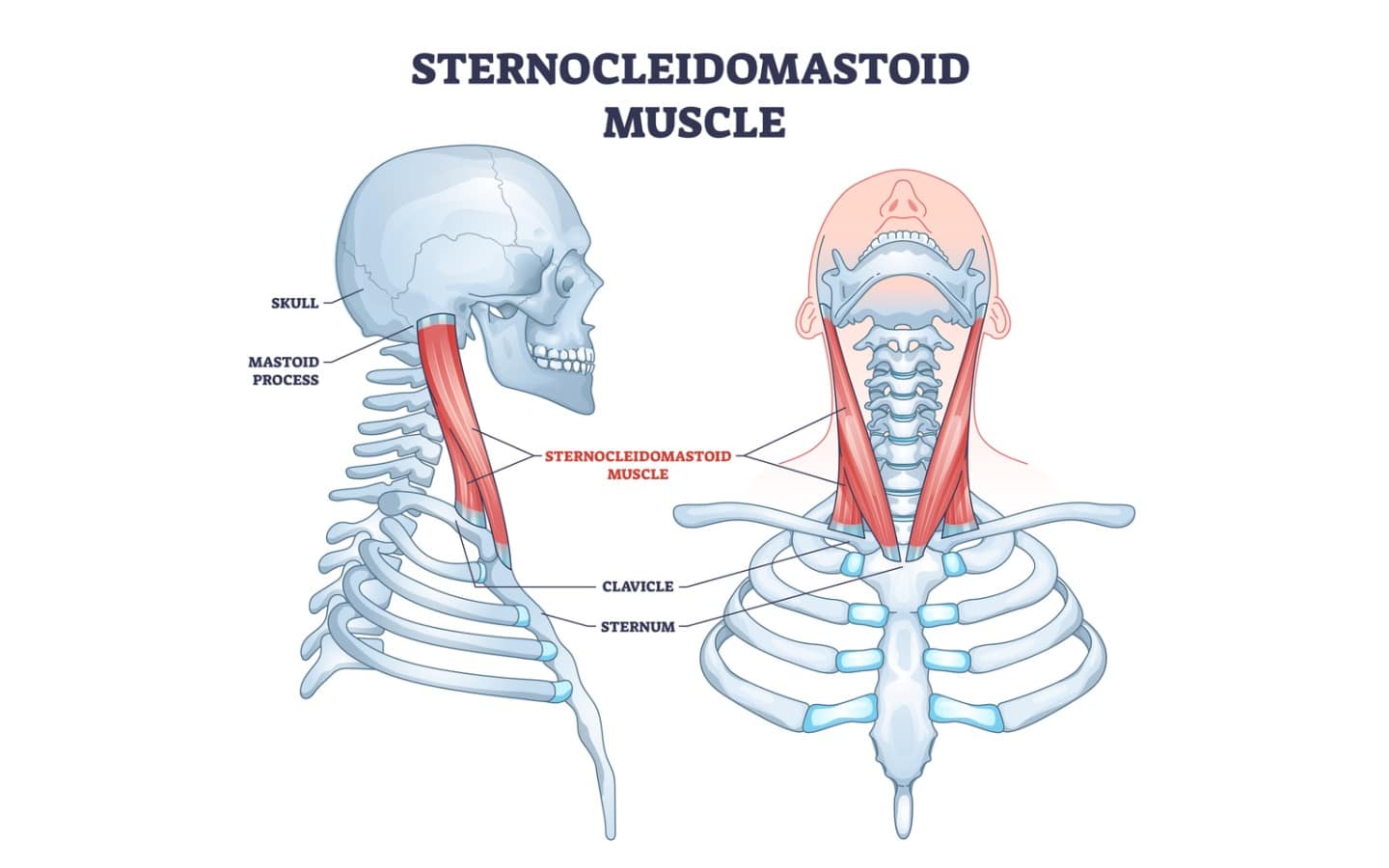
You have one on each side of your neck. They wrap forward and down from their origin points on the mastoid processes at the base of your skull near your ears, and split to attach on two separate points on each side of your upper chest: on your collarbone and on the top of your sternum. And while this muscle’s name is clunky to say, it actually contains the origin and insertions: sterno- (sternum), cleido- (collarbone) mastoid (mastoid process).
The action of your SCM muscles depends on whether they are working one at a time or in tandem. Individually, they assist with rotation of your neck (to the opposite side) combined with forward nodding. When both sides contract together, they push your head forward, a motion called protraction.
If you actively protract your head, jutting your chin forward, you will probably be able to feel your SCM muscles contract if you touch either side of the center notch of your collarbone. You might also notice that this motion replicates ‘forward head posture,’ a position we are warned to try to avoid, especially in prolonged seated work. However, since it is usually gravity and not muscle activity that sinks us into forward head posture, your SCM muscles are not often as overactive in poor posture as other muscles at the back of your neck and shoulders that are tensioned as we curl towards our screens(1). Your SCM muscles can still become shortened and restricted after prolonged time in forward head posture, though, and develop trigger points and sensitivity that can play a role in chronic headache, neck pain, and even tinnitus (ringing in your ears)(2, 3).
If you are encountering chronic headaches, tinnitus, neck pain radiating toward your jaw or ear, or tightness at the front of your neck, your SCM muscles may be implicated. Your PT can assist with releasing and stretching these muscles and retraining your posture to avoid future aggravation.
By Joanna Binney